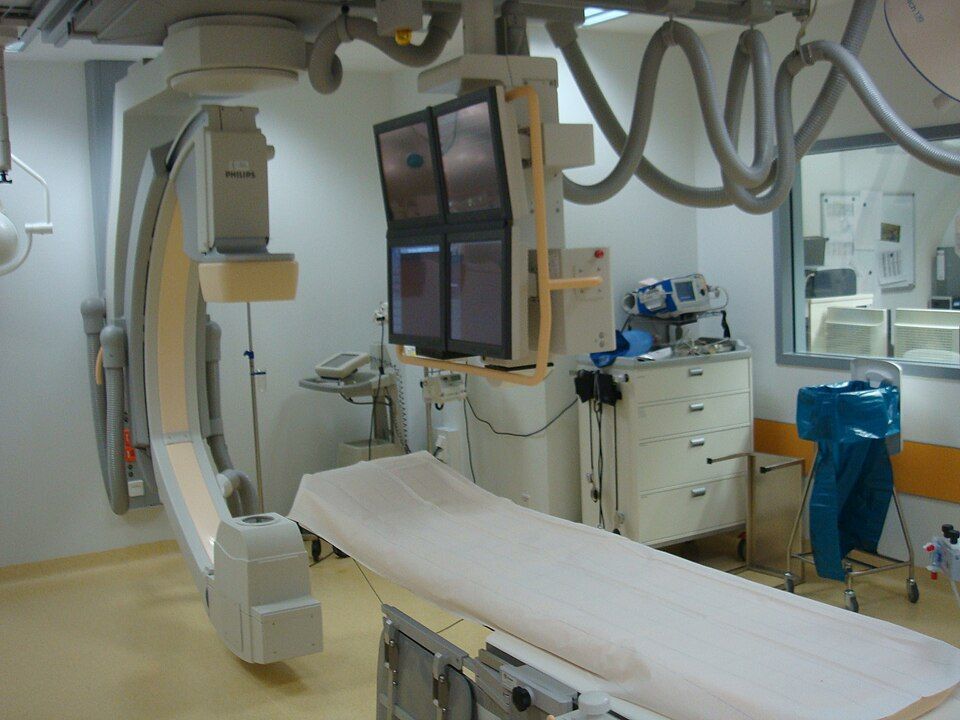
Diagnostics
Cardiac catheterisation
What is cardiac catheterisation?
A very thin, flexible plastic tube (the catheter) is advanced through a blood vessel to the heart.
Access is usually:
The procedure is usually performed under local anaesthesia. You remain awake and normally feel no pain – at most a slight pressure.
- via the groin (femoral artery), or
- via the wrist (radial artery)
How is the examination performed?
During the examination you may feel a brief warmth from the contrast medium – this is normal and harmless.
The examination itself usually lasts between 20 and 60 minutes.
What can cardiac catheterisation show?
With this examination, physicians can:
It is most often performed when coronary heart disease (CHD) is suspected.
- detect narrowings or occlusions of the coronary arteries
- assess the pumping function of the heart
- examine the heart valves
- measure pressures in the heart
- investigate congenital or acquired heart defects more closely
What can be treated immediately?
A key point: in many cases treatment can be performed in the same session.
For example, it is possible to:
This can improve blood flow to the heart muscle and relieve symptoms such as chest pain (angina pectoris). In myocardial infarction, catheter treatment is often performed immediately to reopen the occluded vessel.
- widen narrowed vessels with a small balloon (balloon dilatation)
- place a stent so that the vessel remains open
Is the examination dangerous?
Cardiac catheterisation is now a routine and frequently performed procedure. As with any medical intervention there are possible risks (for example bruising at the puncture site, rarely vessel injury or rhythm disorders). Serious complications are uncommon.
You receive a detailed explanation beforehand, and the medical team monitors you carefully during and after the procedure.
What happens afterwards?
- Pressure dressing at the puncture site
- Several hours of rest (depending on the access site)
- Usually a short period of inpatient observation
- If the course is uncomplicated, discharge is often on the same or the following day
In summary
Cardiac catheterisation is an established procedure for diagnosing heart disease precisely – and often for treating it in the same session. It allows targeted therapy and can in many cases prevent or treat serious events such as myocardial infarction.